
FinBedrock Research · November 2026 · Baseline edition
Store Credit Card Statistics: Deferred Interest, APRs and Who Issues Them
By Nick Buinenko · Data as of · Updated quarterly
How many store credit cards carry deferred interest, which banks issue them, and what a missed promo deadline costs, read from each issuer's own terms for every store card we review. Free data to download.
39.44 %
28 of the 71 store cards in the FinBedrock dataset (39.4%) carry a deferred-interest plan, per the issuers' own documents; 6 more are unclear.
As of November 7, 2026
$215.64
A $1,200 purchase on the My Best Buy Credit Card with a 12-month deferred-interest promotion at 30.99% APR, paid down to $100 by the deadline, is charged $215.64 in interest back to the purchase date — more than twice the $100 left unpaid.
As of November 7, 2026
77.46 %
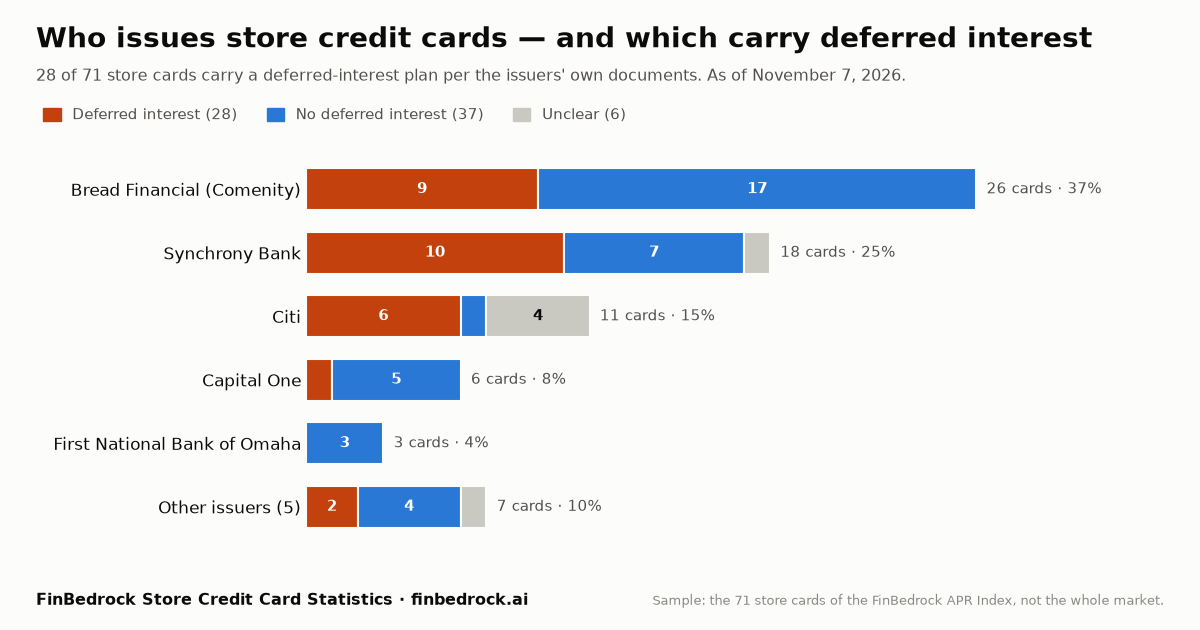
Three banks issue 55 of the 71 store cards in the FinBedrock dataset (77.5%): Bread Financial (Comenity) (26), Synchrony Bank (18), Citi (11).
As of November 7, 2026
66.20 %
47 of the 71 store cards (66.2%) are closed-loop: they work only at their own retailer.
As of November 7, 2026
Black Friday is when store cards get pushed hardest: “save 20% today” at the register, “no interest for 12 months” on the TV you’re about to buy. This study looks at what those 71 store cards actually are once you read the issuer’s own paperwork: how many carry deferred interest, which banks stand behind them, and how much a missed promo deadline really costs.
The cards are the 71 store cards in the FinBedrock Credit Card APR Index, the same card set and the same date (November 7, 2026), so the two studies never disagree. For every one of them we read the card agreement, the pricing terms or the issuer’s own offer page and recorded whether it offers a deferred-interest plan. No card was counted from a review, a forum or a guess.
One limit up front: this is the FinBedrock sample of store cards, not every store card in the US. It covers the retailers we review, from department stores and furniture chains to tire shops and gas stations.
What the data shows
These are observations only, straight from the dataset. What they mean for your wallet comes further down.
- 28 of 71 store cards (39.44%) carry a deferred-interest plan. For 37 cards the issuer’s documents show no such plan, and 6 are unclear: the documents allow one without naming it, or none could be reached.
- Deferred interest lives on closed-loop cards. 25 of the 47 closed-loop cards carry it, against 3 of the 24 open-loop Visa, Mastercard and American Express co-brands.
- Three banks issue most store cards: Bread Financial (Comenity) 26, Synchrony Bank 18 and Citi 11, together 77.46% of the sample.
- The issuers split sharply. Synchrony Bank carries a deferred-interest plan on 10 of its 18 store cards, Bread Financial (Comenity) on 9 of 26, Capital One on 1 of 6.
- Two in three are closed-loop. 47 of the 71 work only at their own retailer.
- They cost more to carry a balance on. Store cards in the FinBedrock dataset carry a median maximum APR of 33.24%, 4.75 percentage points above the 28.49% median for bank cards (71 store cards, 81 bank cards).
Deferred interest
No deferred interest
Unclear
28 of 71 store cards (39.44%) carry a deferred-interest plan. How to read it: Counted only from each issuer's own documents. "Unclear" cards are not counted either way: if every one of them turned out to have deferred interest, the share would be 47.89%; leaving them out, it is 43.08% of the cards that could be decided. Unclear: Dillard's Credit Card, Exxon Mobil Smart Card+™, Meijer® Mastercard®, Target Circle Card, Techron Advantage® Visa Card, Tractor Supply Credit Card.How many store cards carry deferred interest
The issuer chart below shows every bank with at least 3 store cards in the sample, split by deferred-interest status. The remaining issuers are grouped at the bottom.
Deferred interest
No deferred interest
Unclear
Issuer = the bank that issues the card. Issuers with fewer than 3 store cards are grouped as "Other issuers": First Bank & Trust (2), TD Bank USA, N.A. (2), Barclays (1), Chase (1), Credit First National Association (1).
Who issues store credit cards
Deferred interest is not a 0% APR. Interest builds up from the day of the purchase; it is waived only if the whole promotional balance is gone by the deadline. Leave anything at all and the issuer charges all of it at once. Here is what that looks like on a real card from the sample, at its own purchase APR. Citi’s agreement for this card says interest compounds daily, so the upper-bound figure is the closer one.
My Best Buy Credit Card (Citi), 30.99% purchase APR,
a $1,200 purchase on a 12-month deferred-interest promotion.
How it's computed: FinBedrock's deferred-interest calculator: interest on the declining balance at the card's APR divided by 12 each billing cycle, payments at the end of each cycle, charged in full at the deadline. Issuers that compound daily land closer to the upper bound.What a missed deadline costs: one real card
The interest is charged on the balance as it went down over the year, not on the original $1,200 for the whole year. It still lands as one charge, and being short by a single dollar costs nearly the same: $201.58.
Closed-loop cards also run at higher rates than the open-loop co-brands:
Median highest APR. Closed-loop cards work only at their own retailer; open-loop co-brands work anywhere the network is accepted.
Lowest APR, median: closed-loop 33.99%, open-loop 22.79%.
APR range: closed-loop 16.99–35.99%, open-loop 17.74–35.99%.
Closed-loop vs open-loop store cards
And the store-card premium over bank cards, from the APR Index:
Store cards are +4.75 percentage points higher at the top of the APR range. These figures are copied from the FinBedrock Credit Card APR Index edition this study is built on (data as of November 7, 2026), so the two studies always agree.Store cards vs bank cards
Highest APR (median)
Lowest APR (median)
What this means for you
Everything above is data. This section is our interpretation of it.
Read “no interest” twice before Black Friday. Two very different plans hide behind the same words. On a deferred-interest plan (“no interest if paid in full within 12 months”), a balance left at the deadline brings back every month of interest. On a waived-interest or equal-payment plan (“0% for 12 months”, “no interest with equal monthly payments”), you only start paying the regular APR on what is left. Several cards in this sample advertise “no interest” plans of the second kind, including Capital One’s Kohl’s, BJ’s and REI cards. The issuer’s terms say which one you are getting; ask for them at the register.
If you take a deferred-interest plan, divide by one month less. The payment that clears the promo exactly on time leaves no room for a late posting. Paying the purchase off one billing cycle early is the safe version. The deferred interest calculator gives both numbers for any purchase, and our guide to how deferred interest works covers the rest of the traps.
Don’t carry a balance on a store card at all. The median highest APR on store cards is 33.24%, and on closed-loop cards 33.99%. Use a store card for the discount or a promotion you can clear, then pay it off. Whether one is worth opening on Black Friday at all is the question our Black Friday store card guide answers, and are store credit cards worth it runs the longer math.
Know which bank you’re signing up with. Most of these cards come from three banks. If yours says Comenity, our guide to Comenity Bank (Bread Financial) explains who you’re dealing with; for Synchrony cards, see what Synchrony Bank is. Every store card we’ve reviewed is ranked in the best store credit cards.
Free to use with attribution (CC BY 4.0).
The CSV has one row per card, including cards of issuers too small for the table.
Download the data (CSV)
Download the chart (PNG)
Use this data
Source: FinBedrock Store Credit Card Statistics, November 2026 — https://finbedrock.ai/research/store-credit-card-statistics/
Sample. The study covers the 71 store cards in the FinBedrock Credit Card APR Index edition dated November 7, 2026 (152 cards in that edition in all). It uses the Index’s card set, APRs and as-of dates unchanged, so every APR figure here matches the Index. A store card is a card carrying a retailer’s brand: closed-loop cards that work only at that retailer, and Visa, Mastercard or American Express co-brands with a retailer, gas-station brands included. This is the FinBedrock sample, not every store card in the US. Deferred interest: how each card was decided. For every card we read the issuer’s own document: the card agreement, the pricing addendum, the issuer’s or retailer’s offer terms, or the CFPB credit card agreement database. A card counts as having deferred interest when that document names a current plan that charges interest from the purchase date if the promotional balance is not paid in full (“no interest if paid in full”, “deferred interest”). It counts as not having one when the document lists the card’s plans or balance types and none of them is deferred interest; many of these cards offer waived-interest or equal-payment plans instead, which charge no interest back. It counts as unclear when the document only allows such offers in general terms, or when no issuer document could be reached. Unclear cards are never counted either way. Reviews, forums and comparison sites were never used to decide a card. Agreements that name their plans. Comenity (Bread Financial) and Synchrony agreements list a card’s own promotional plans when it has any; an agreement with only the general clause that every one of them carries was counted as no deferred-interest plan. Citi’s retail agreements carry a general deferred-interest clause whether or not a card runs such offers, so for Citi cards we needed the offer itself, or a plan named in the agreement. That is why most unclear cards are Citi’s. Issuers. A card is assigned to the bank that issues it, as in the APR Index. Comenity Bank and Comenity Capital Bank are reported together as Bread Financial (Comenity). Issuers with fewer than 3 store cards are grouped as “Other issuers”; their cards count in every total. Worked example. The example card is a real card from the sample with a deferred-interest plan, at its own purchase APR from the Index. The figures come from FinBedrock’s deferred-interest calculator engine: interest on the declining promotional balance at the APR divided by 12 for each billing cycle, payments at the end of each cycle, all of it charged at the deadline. Some issuers compound interest daily, which raises the charge; the calculator’s daily-compounding figure is shown as an upper bound. Interest after the deadline is not included. APRs and store vs bank. All APR figures, and the store-card vs bank-card comparison, are copied from the APR Index edition, not recomputed; the Index methodology explains how each APR was verified. Updates. The study is updated quarterly, each time on that quarter’s APR Index edition, and each edition is kept. This November 2026 edition is the first. Deferred-interest offers change more often than card terms do; a plan can be added or withdrawn between editions.Methodology
How the study is built
Definitions
Sources
Frequently Asked Questions
How many store credit cards have deferred interest?
In the FinBedrock dataset, 28 of 71 store cards (39.44%) carry a deferred-interest plan, as of November 7, 2026, counted only from each issuer’s own documents. 37 do not, and 6 are unclear. This is the sample of store cards FinBedrock reviews, not every store card in the US.
What is the difference between deferred interest and 0% interest?
On a deferred-interest plan, interest builds up from the purchase date and is waived only if the whole promotional balance is paid by the deadline; leave anything and all of it is charged at once. On a true 0% or waived-interest plan, you pay no interest during the promotion and only start paying the regular APR on what is left. Several store cards in this study offer the second kind. Our deferred interest guide walks through both.
How much does missing a deferred-interest deadline cost?
On a $1,200 purchase on the My Best Buy Credit Card at 30.99% APR with a 12-month promotion, paid down to $100 by the deadline, the back interest is $215.64, and up to $263.39 with daily compounding. Being short by just $1 costs $201.58. Try your own numbers in the deferred interest calculator.
Which banks issue the most store credit cards?
Three banks issue 55 of the 71 store cards in the FinBedrock dataset (77.5%): Bread Financial (Comenity) (26), Synchrony Bank (18), Citi (11).
Are store card APRs higher than regular credit cards?
Yes, in this dataset. Store cards in the FinBedrock dataset carry a median maximum APR of 33.24%, 4.75 percentage points above the 28.49% median for bank cards (71 store cards, 81 bank cards). Closed-loop store cards, which work only at their own retailer, have a median highest APR of 33.99%. The figures come from the FinBedrock Credit Card APR Index.
Can I use this data?
Yes. The data is free to use with attribution under CC BY 4.0. Download the CSV, one row per card with its deferred-interest status and the issuer document it was read from, from the “Use this data” section of this page.

This content is for informational and educational purposes only and does not constitute financial advice. Credit card terms and APRs change — always verify current details directly with the issuer before applying.